Whoa!
I remember the first time I tried moving assets across chains—total chaos.
My instinct said there had to be a better way, and honestly there is.
At first I thought browser wallets were all the same, but then I started testing, switching networks, and digging into UX quirks that most write‑ups ignore.
By the end I had a shortlist of what actually matters for daily DeFi use, and somethin’ about that list surprised me.
Really?
Yes—multi‑chain support isn’t just a checkbox.
It’s about seamless identity and gas management across EVMs and non‑EVMs.
On one hand users want simplicity; on the other hand they need granular control, especially when interacting with unfamiliar dApps or bridges.
So the wallet you pick can either make you confident or make you nervous every time you confirm a tx.
Hmm…
Security used to feel like a faraway thing to new users.
Now it has to be front and center.
I saw a friend nearly sign a malicious approval because the prompt hid key details—this part bugs me.
Actually, wait—let me rephrase that: the UI often buries allowances and nonce info, which is very very important for anyone who cares about fund safety.
Whoa!
A good extension wallet should reduce surface area for mistakes.
It should warn you when a dApp requests broad approvals and offer alternatives like permit-based interactions.
Initially I thought transaction simulation would be optional, but then I realized when you can preview contract calls, fewer people panic and fewer costly mistakes happen.
On top of that, well‑designed gas controls and clear chain labels matter a lot when you hop from Ethereum to an L2 or a Cosmos zone.
Seriously?
Yes—UX details change behavior.
For example, adding custom tokens across multiple chains should be automated, not manual.
When it isn’t, users copy-paste wrong addresses, or they add testnet tokens to mainnet views and freak out… which is avoidable with a smarter extension.
I’m biased, but automated network discovery and clear token provenance save time and reduce support tickets.
Whoa!
Interoperability isn’t just about supporting many chains.
It requires handling different signature schemes, gas tokens, and even transaction primitives (IAB was a recent surprise to me).
On some chains fee tokens and account abstraction shift how confirmations and nonce management work, so the wallet must adapt rather than force a one‑size approach.
If your wallet treats every chain like the same horse, you get stumbles—sometimes costly ones.
Hmm…
Privacy is another layer people overlook.
A browser extension lives in your browser context, and that surface is noisy—tracking, tab leakage, extensions talking to each other.
So good isolation practices, minimal permissions, and clear connection flows are non‑negotiable.
On the flip side, too many prompts make users click blindly, so balance is crucial.
Whoa!
Performance matters.
No one wants a sluggish extension when approving trades or switching networks mid‑arbitrage.
Caching, lightweight key derivation, and selective on‑chain queries keep latency down without sacrificing safety.
And yes—offline signing flows and hardware wallet integrations are the difference between hobby trading and professional-grade operation.
Here’s the thing.
Not every wallet nails all these pieces.
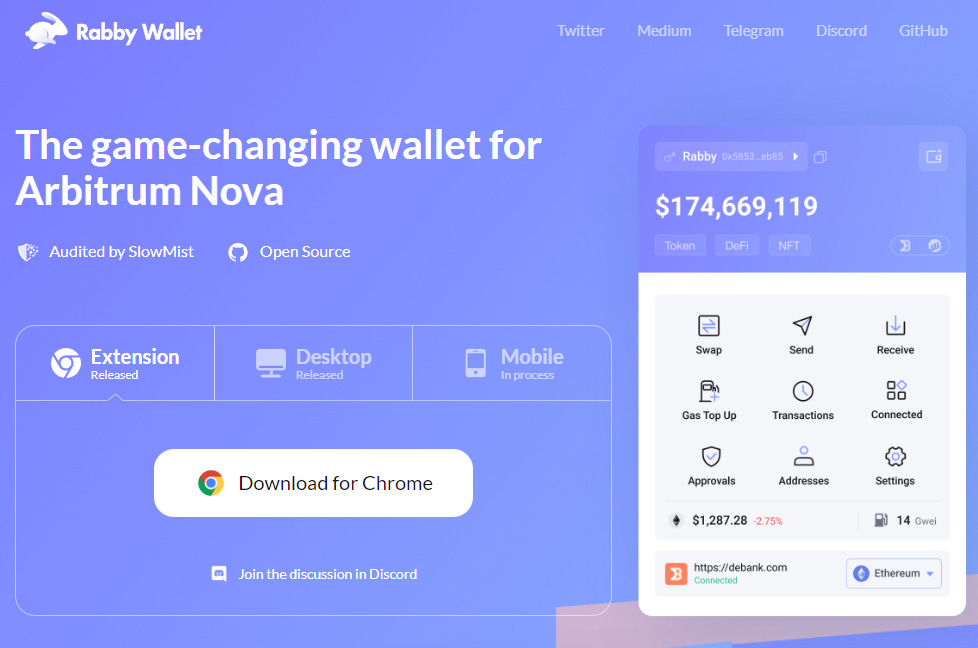
But there are options that come close, and one I’ve used in production feels particularly tuned for multi‑chain DeFi: rabby.
They built features with traders and power users in mind—things like batch approvals, per‑site permissions, and clear simulation previews—which change how risk is perceived.
If you care about crossing chains with confidence, that’s worth checking out.
Practical selection checklist
Whoa!
Pick a wallet that gives you granular permission controls.
Pick one with transaction simulation and permission history.
Pick one that integrates with hardware wallets and supports account abstraction patterns where relevant.
And pick one that makes multi‑chain recovery straightforward—seed phrases alone are a brittle story across diverse ecosystems.
Initially I thought security was all about cold storage, but then realized everyday UX drives more losses than cold storage lapses.
On one hand your keys should be secure; though actually, the ways users interact with approvals, and the defaults chosen by the wallet, decide whether that security is effective in practice.
So look for sensible defaults and clear risk signals—don’t trust a pretty interface alone.
Whoa!
Community and audits matter too.
A small, vetted team that iterates and listens to users will fix emergent issues faster than a vanity brand.
I check release notes and third‑party audits before recommending a tool to friends.
If the project has transparent roadmaps and active response cadence, that’s a good sign.
FAQ
Do I need a multi‑chain wallet if I only use Ethereum?
Short answer: maybe.
If you interact with L2s or bridges you already cross chains indirectly.
A multi‑chain wallet simplifies that process, reducing mistakes when you approve cross‑chain bridges or L2 deposits.
If you plan to grow into DeFi beyond basic ETH trades, it pays to start with a wallet that handles multiple environments gracefully.
How do I keep my browser wallet safe?
Use hardware signing for big moves.
Limit site approvals and revoke unused allowances.
Keep your extension updated and watch for social‑engineered prompts—phishing still works.
And consider an extension that surfaces simulations and approval history so you can audit interactions before confirming.
What’s the tradeoff between convenience and security?
Convenience speeds adoption, but it can introduce risky defaults.
Good wallets minimize friction while offering opt‑in strong protections, like batch signing with explicit scopes or time‑bounded approvals.
I’m not 100% sure there will be a perfect balance, but a wallet that evolves with user feedback is likely the best compromise.